
|
|

|
| See Homepage. | This page: Laying up a classic car in storage for a period of time. |
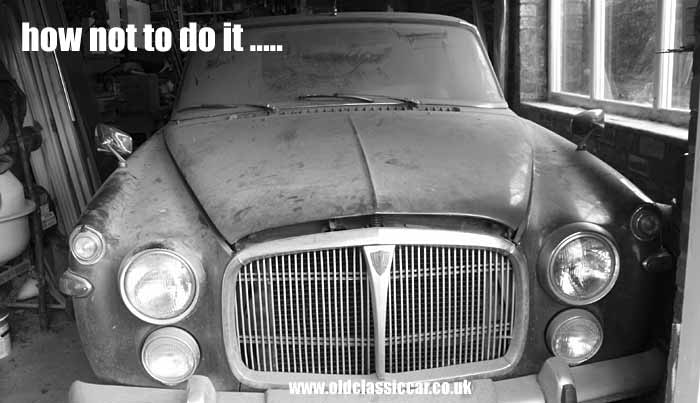
How to lay up a car.A good clean.Firstly I'd recommend giving the car a good clean - inside, underneath and on top. Wash down the car (don't forget the door shuts) and allow it to dry out thoroughly, speeding it up with a chamois leather if necessary. Ideally pick a dry breezy day, which will help with drying the nooks and crannies before putting the car away finally. Touch-up any stonechips if you find any. If possible, give the car a thorough waxing and perhaps leave a thin coat of wax on any chromework. Also attend to the underside, hose out any accumulations of mud and again, let it dry out thoroughly. A quick drive around can speed up the process. The interior will also benefit from a vacuuming and general tidy up - boiled sweets, food wrappers and old petrol station receipts can be cleared out and disposed of at this point, leaving everything neat and tidy for when the car is to re-enter service once more - don't forget the boot either! If the car has leather interior trim, now is the perfect opportunity to treat it with hide food, this will not only help preserve the leather but also the stitching, which won't take kindly to being left damp for a long period of time, if the seats were wiped down during the tidying-up procedure.If the car is to be stored in a garage, alongside a window, bear in mind that strong sunlight (remember that?) will not only fade seats, door panels and the top of the dashboard, but will also lead to trim pieces drying out and possibly cracking much sooner that would have been the case, had it been stored in the dark. Cotton sheets placed over the interior panels will help here. Similarly sheets can also be placed over the entire car, if the garage is dry. This not only protects the car from sunlight, it minimises the dust that'll settle on the paint, plus disguises the car somewhat if people are able to peer in from outside. Tailored covers will also do the trick. I wouldn't use thick blankets though as they could harbour moisture in the air, with dire consequences for the paintwork beneath. Parking the car in a garage.Leaving a car outside, not moving, for a long period of time will do it no favours at all, so thoughts should really go to finding a garage, or other suitable under-cover storage. There are mixed views on whether a car should be jacked up or not while in store. Certainly supporting a car on proper stands will avoid the tyres developing flat spots, and covering them will help the rubber too, it also introduces an extra level of security given that most thieves won't want to be messing around with jacks and spanners, re-fitting wheels to a car. If the car is to stay on its wheels, pump up the tyres to the maximum permitted pressure specified in the handbook (or a little over, say +10 psi), and ensure that the handbrake isn't left on as this can stick during a period of inactivity.Mechanical checks.Servicing the car prior to being laid up tends to be worthwhile also. Not only does a greasing ensure that the joints, wheel bearings etc remain in good, un-corroded order, it will be one less job to attend to when the car is brought back into life, unless several years have elapsed in which case a more thorough check-over would be required anyway. Check that the anti-freeze is up to strength and to the correct level, and given how quickly modern fuels can go "off" it could be worth draining the fuel tank, although only tackle this if you're happy doing this and have suitable containers to store the fuel that will drain out, prior to disposal. A few months storage and the fuel will probably be ok to run with again, but much over six months or so and it'd be wise to drain it off, or at least park the car up once the fuel level has run quite low. Fresh fuel can be added in and mixed with the old when the car is re-commissioned.Still with the engine, it doesn't harm to remove each spark plug and pour a drop of oil down each bore, followed by a few turns on the crankshaft. Re-fitting the plugs and sealing the carburettor inlet(s) will prevent dampness from entering the cylinders. If the car has a mechanical clutch, then propping the pedal down with a block of wood can prevent it seizing, although I'm not sure about keeping the mechanism under load for several months being a good idea myself. I certainly wouldn't do this with a car that has a hydraulically-operated clutch, nor would I block down a brake pedal if connected to a hydraulic system. Personally I prefer to run cars up every now and then, drive them backwards and forwards, and exercise everything that way to prevent seizure of brake or clutch components. Running at a fast idle for a minimum of say 25-30 minutes, not less, should enable everything to warm through yet avoid creating and leaving condensation within the engine and exhaust. If you can't fire up the car and warm it through properly, turning the engine over, either on the starter or on a handle, is a good idea. The battery will also benefit from regular use, plus a trickle charger will help keep it in tip-top order. I'd also be inclined at this stage to change the oil and filter, as leaving old oil for long periods of time in an engine isn't usually recommended. Even a bargain-basement supermarket oil will suffice for use during storage. Other notes on storing a car.It may be worth advising your insurance company if laying up a car for a period of time, you may even save some money if switching to laid-up cover for a time. If the car is to be kept away from its home address then the insurers will definitely need to know about it. As already hinted at, exercising some of the car's systems is a very good idea, usually. Warming the car through drives out any moisture that may have gathered, and lessens the chances of things seizing or not working properly when the car is awoken from its slumbers. While running the engine up to full temperature, switch on all the lights, this not only exercises the charging systems, but will also dispel any dampness that has formed within the light units, possibly saving you the expense of having to re-silver headlamp reflectors.Turn the engine over regularly, and rotate the wheels if the car is on jacks. Make sure all the door locks are lubricated, and if possible open all the doors allowing the interior to breath. I wouldn't leave doors open for lengthy periods, in case local mice decide to take up residence, but opening them for a few hours at a time, and leaving the windows down an inch or so, will help ward off dampness and musty odours. Raise the bonnet every now and then to check for evidence of mice. If you're parking on a concrete floor, you may find that condensation will form on the underside of the car. Opening the garage doors on dry days, plus the use of a de-humidifier, can help minimise this. Spraying old engine oil or applying branded anti-corrosion preparations to the car's vulnerable surfaces, will help protect the car's structure from the effects of dampness such as this. Hopefully these few pointers will go some way in minimising the time and effort that will be required to get the car back into service, when the time comes to re-awaken it. |
|


|

Custom Search
|
 |
| Old Classic Car (C) R. Jones 2026. Content not to be reproduced elsewhere. |
| Website by ableweb. |
| Privacy Policy, Cookies & Disclaimers |