This is the first of two photo pages concentrating on the Ford 100E in its various guises. First up, a colour photograph sent over by Alan, with Anglia registration TRY 43 parked at the kerbside, with typical suburban semis in the background.
The 100E - Ford's new saloon for the 1950s.
Alan says: "The Ford Anglia was our car before the Cambridge, photographed at Millmead Road, Cliftonville in 1963, the registration is now on a Honda I believe."
This is a super photo - thanks to Alan for sending this and the others in. In the foreground is the family Ford 100E Anglia, with a BMC 1100 (Wolseley?) parked on the other side of the road, with another 100E rear-end-on in the distance. What I like about these old photos is the lack of road furniture, I bet if you revisit this road now there would be speed humps, signs, poorly refinished road repairs (I don't remember the last time I saw such a smart road surface!!), litter, and probably lots more cars, either parked or racing by. A bit of research tells me that Millmead Road is down in Margate, Kent, and still very much in business (you can even see a map of the road here if you really want to!).
But back to the 100E Ford. The New Anglia and Popular were launched in the early 1950s, and were a breath of fresh air in the small-car market for Ford. Hitherto the Dagenham car maker could only offer warmed-over versions of their pre-war 1172cc sidevalve cars, either rated at 8hp or 10hp. What they needed was something altogether more modern, to take on fresh designs such as the Austin A30 and Morris Minor. The crisp 3 box styling was bang up-to-date, although it did hide some throwbacks to the older upright Fords.
Anglias, Populars and other 100Es (they also came as a van and estate car) were again powered by a sidevalve engine, still of 1172cc, and a derivative of the older 10hp engine. It did feature some updates to the old design, but was still outclassed by the modern OHV units that appeared in A30s, A35s and Series 2 Minors. It also had a 3 speed gearbox, when 50s new-car motorist was really wanting 4. Despite the mechanical side of the car being a little 'old hat', buyers looking for a cheap new car flocked to the Ford dealerships and bought 100Es in large numbers. Production continued through the 1950s, until the 105E came along. Towards the end of 100E production, a special version called the 107E Prefect was marketed. Visually it looked similar to the 100E Prefect, but had the benefit of the 105E OHV engine, and 4 speeds, which made a huge difference. I owned a 107E for a while and it was definitely an enjoyable car to bowl along in.
As mentioned, there was also a van version, rated at 5cwt or 7cwt, and called the 300E. There were two estate car versions of the 100E saloon - the basic Escort estate (first time Ford used this model name I believe), and the Squire, early examples of which had wooden styling trims tacked onto the body sides.
2. A 100E Prefect parked outside the Manor House Inn pub.
Since publishing the 100E photo above, I stumbled across this neat old photograph. Seen from behind is a basic 100E Ford Prefect, registration SUV 613, parked with two chaps outside the Manor House Inn, a Starkeys Ales public house it would seem. Initially I thought this was a Pop, but I'm told the 4 doors on this car means that its the Prefect version.
A little detective work confirms that this establishment, which dates to the 16th Century, is still in business, and still called the Manor House Inn. It is located on St Mary's Road, Croyde, Braunton, in Devon. Their website is currently being built but will hopefully contain some photos showing how the building looks now. A small photograph showing the Manor House Inn as it is today features on this Devon food website.
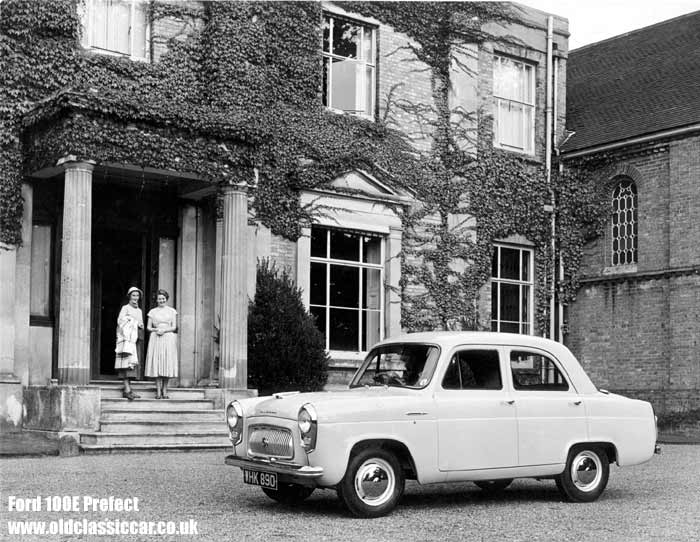
3. Ford 100E Anglia & Prefect press photographs.
David B emailed these two photographs over for use on the site. They were both issued by Ford at the launch of the respective models, ie the 100E Anglia and 100E Prefect.
A typewritten note that came with the photographs reads as follows:
"The New Anglia and New Prefect bring to the motoring world an unprecedented combination of stylish appearance, roominess, performance and economy at prices which symbolise Ford "Value for Money" policy.
Many mechanical features, which have received universal praise in the famous Consul and Zephyr Six, such as the unique I.F.S. and hydraulically operated clutch are to be found with similar standards of comfort and safety in these latest additions to the Ford range. Both cars are powered by an entirely new 1172cc engine developing 36 bhp @ 4,400 rpm."
4. A 100E alongside an E493A.
The next snapshot shows a Ford 100E Anglia parked in a field. Registration LUH 911, a Cardiff series first used in 1955, it isn't hard to imagine what car would now be wearing that registration had the Anglia survived into recent times. It looks to be in pretty standard condition, other than twin wing mirrors, an AA badge, a steering wheel glove, and a suction-fit demister fitted to the rear window. Parked alongside the 100E is an E493A Prefect from the same stable.
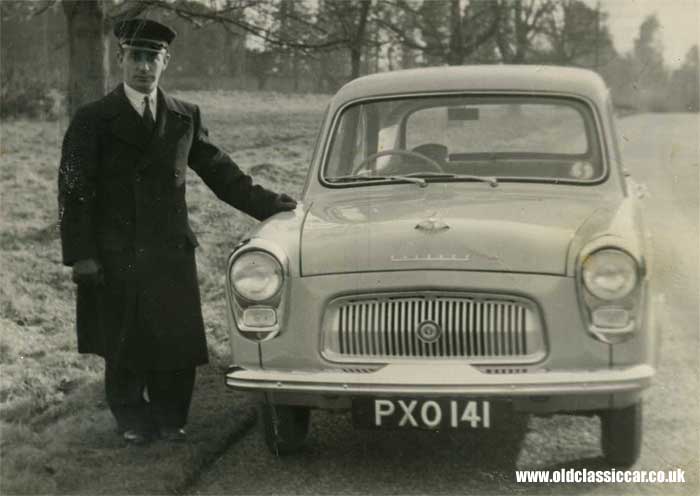
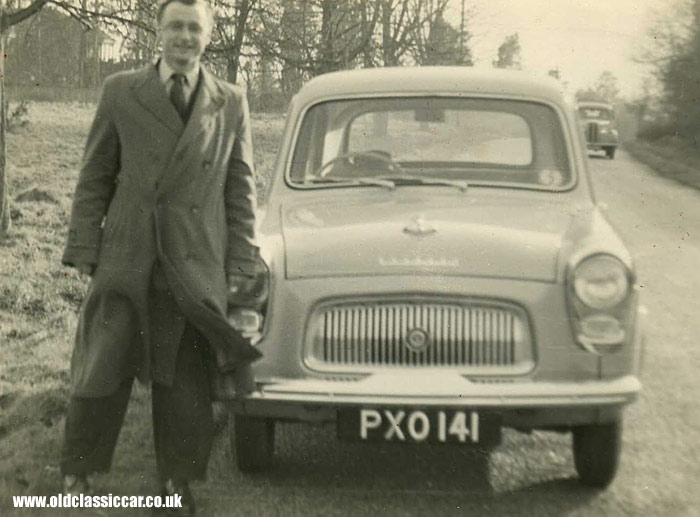
5. Two photos of a 100E Ford Prefect.
This next pair of old-car photos show a light-coloured 100E Prefect, reg PXO 141. The first shows a chap in overcoat and cap, I can't see a badge on his hat so maybe he always dressed like this when driving the Ford. I doubt he was a chauffeur for the other gent, also photographed with the 100E on a winter's day. Note the upright Pop or Anglia pootling along in the background of the second photo.
(Please click the thumbnail to view full-size image.)
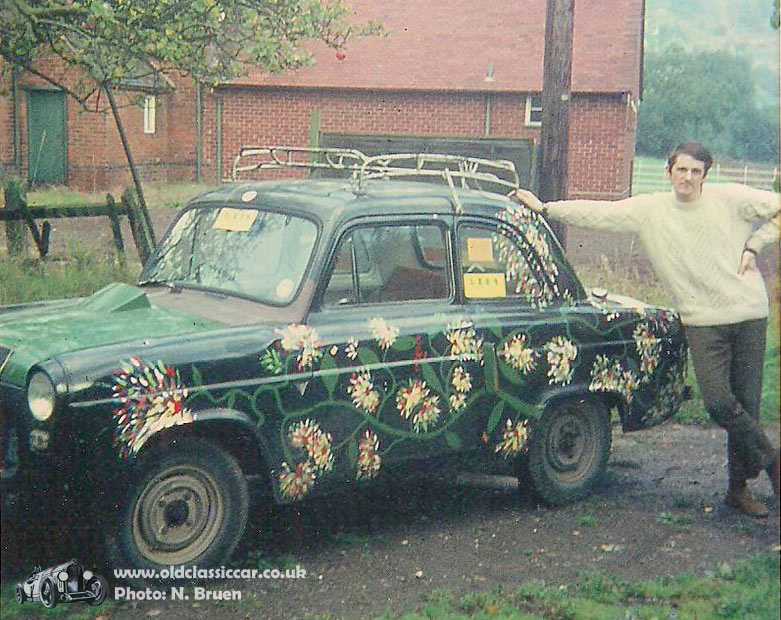
6. A "flower power" tuned 100E in the 1960s.
Nigel has sent over several interesting old photographs to share on the site. Amongst them is this colour photo from the 1960s, where he's shown posed alongside his trusty "flower power" 100E Ford, in 1967. Regarding this tuned-up multi-coloured 100E he adds:
"Back in 1967, I had this Ford as my car while carrying out my business of showing psychedelic light shows in the Midlands. The business was called 'LX84', as indicated by the window stickers, and I provided Light for such luminaries as: Dave Dee Dozy Mick and Titch, Eric Burdon and the Animals, The Yardbirds, The Who, The Nice, The Cream, Crazy World of Arthur Brown, Judy Driscoll and the Brian Augar Trinity and Jimmy Hendrix. The colour scheme on the car was a crude and early attempt at marketing and, in order to keep legal, every colour had to be registered in the log-book. However, the car was not only of rather strange appearance; it was also a Q-car (after the Q-ships of the first and second world wars, that looked like ordinary merchant ships until the enemy raider approached too close when the upperworks would fall away to reveal large calibre armament that would hopefully blow the enemy ship out of the water, and thus protect the convoy.)
"The Flower Power Car, as it was known, had beefed-up suspension and an engine that had been breathed upon by that legendary engine tuner Geoff Richardson of Hartlebury in Worcestershire. He took the 100E engine, stripped it down, balanced it, polished it inside, modified the inlets and exhaust, doubled up the valve springs, fitted a larger SU carburettor and a big-bore exhaust (that can be seen just in front of the rear wheel). So, just the basic tuning but done to the highest standards, particularly with the balancing which was the key factor. Consequently the engine would rev to about five and a half thousand and the car could attain speeds of over 85mph. This may not seem much these days, but back in 1967 it was heady stuff and surprised a few more powerful and expensive cars on the new motorways.
"Sadly, the dreaded rust did for the vehicle in the end, as I heard years later from the person who bought it from me. He was changing a wheel one day and, as one does, was watching to see the tyre lift off the ground while winding away on the jack. The wheel never moved but the jack kept on jacking until he realised the the car was slowly bending in half. End of Flower Power Car.
Brilliant story, and a groovy car. At least it lives on in the virtual world, if not in the real!
A second page of 100E photographs contains yet more period images of this Ford saloon car.
The video below is a compilation of 70 photographs all featuring 100Es in their various forms.
Other items of possible interest on this site.
If you're thinking of buying a 100E as a classic today, this 100E buyers' guide may come in handy. If you'd lived in Co. Kerry in 1957, and a 100E appealed, then perhaps you'd have entered this prize draw to win a brand new 100E Ford Prefect. Some original papers detailing the purchase of a new 100E Popular in 1961, can be found on the (Ford & Fordson agent) Denoon Motors Limited page.
Custom Search
Old Classic Car (C) R. Jones 2026. Content not to be reproduced elsewhere.