I've been interested in E83Ws since 1989 when I bought my first example, from an overgrown field in Wales. Since then I've looked high and low for period photographs of these Fordson (later Thames) 10cwt rated vans, most of which have ended up on my E83W site. It seemed high time that period pictures of E83Ws should feature on oldclassiccar too. A second page added to the site incorporates a collection of 1954 Thames E83W Estate Car pictures.
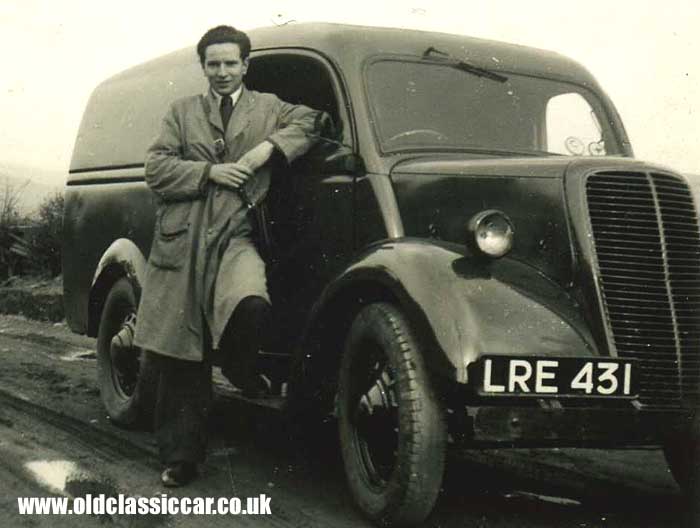
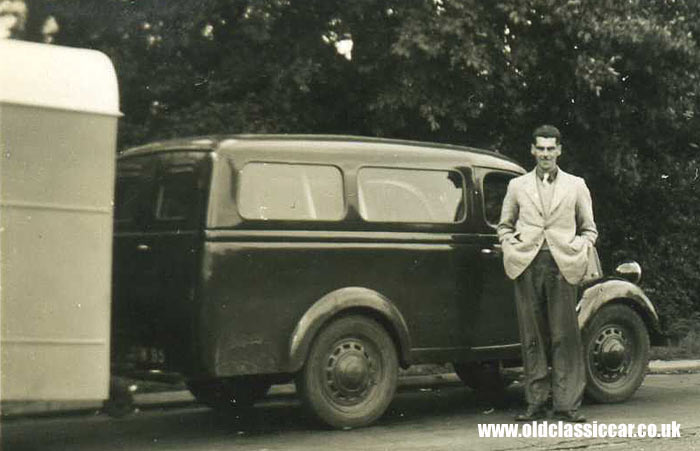
The first E83W van shown on this page is an early example - time to don my vanorak!! First giveaway that this is an early van, is the tiny headlamp fitted to this example. Only some pre-war, and immediate post-war vans had these fitted as standard, later examples having the larger lamps also fitted to the E494A Anglia saloon, and some Fordson tractors. Interestingly the very first 10cwt brochures, from 1938, feature the van with much more bulbous headlamp lenses than even the post-war examples had. Later Thames examples also have a badge on the bonnet sides. The vast majority of E83Ws that survive today have the solid bonnet pulls, whereas this one has the ring-pull catches, as also seen on the smaller 5cwt Fordson E494C type (as on these examples of 5cwt van). Early front wings didn't have a heavily beaded edge, but were prone to splitting in the event of a minor bump, so later E83Ws had a revised and strengthened wing edge.
Although not entirely clear in this photo, I think it has the early pattern grille - ie with just one starter handle hole. The engine in these semi-forward control vans (and pickups) is offset to the passenger side. Therefore RHD UK market vans would have the starting handle hole over to the passenger side. Early vans just had this single aperture, but later examples have two starter holes, presumably when they were marketed overseas, sometimes in LHD configuration. Rather than have two different grille panels in production, it made sense to have a 'one fits all' approach. The grille on this example is slightly bent, a common problem with E83Ws, and it doesn't have the stainless trims fitted either, perhaps a concession to the war and blackout restrictions? If this had been the case though, I'd have expected to see a mask on the visible headlamp.
But back to the van. It has the correct 18" diameter rims (larger than on contemporary Ford saloons), fitted with tyres not overly burdened with tread. Although not obvious from this view, this van may well have had wind-up door windows. Examples from the 1940s and onwards (the E83W was built from 1938 to 1957) would have pull-up side windows, although the windscreen would open on all E83Ws produced.
Just visible in the screen is the Commercial user's 'C' licence, a requirement on commercial vehicles at the time. A close look at the photograph above also shows another giveaway of the early van. The rear arch shape is different. On this van, the arch drops straight down behind the roadwheel. Later examples would flare out and back more, to lessen the chance for mud and road dirt to splatter onto the van's coachwork. The photo of a similar van, at the foot of this page, shows this better.
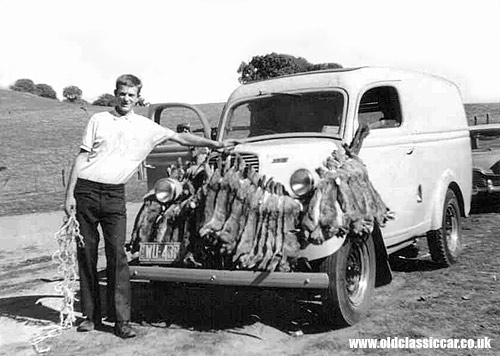
2. An Australian Fordson 10/10 panel van.
Next, a great old photo of an Australian E83W van, known locally as a Fordson 10/10 van (10cwt / 10hp), with the day's catch of rabbits! George kindly sent this photo over, it was his first 10/10 and he plans to restore a 1949 example soon, with new "woodie" estate coachwork.
Talking of coachwork, the E83W was produced in a number of guises at Ford's Dagenham plant, to maximise its flexibility, at a time when there were many coachbuilders in business. A standard van and wooden pickup was offered, and these would be joined by factory produced steel bodied pickups, estate cars, tippers and other variants in the Ford catalogue, as time went on. The E83W could also be ordered in chassis/scuttle form, ie with just the front end panelwork, to be bodied from the screen rearwards for whatever application was required (eg as an ice cream van, or mobile canteen), or as a chassis cab, so that bespoke bodywork could be mounted on the 10cwt chassis, rear of the factory cab. This flexibility lead the E83W to be used in many different trades, and ensured that sales remained strong right into the 1950s.
The E83W was finally pensioned off in 1957, the flat fronted 400E taking over where its pre-war predecessor left off.
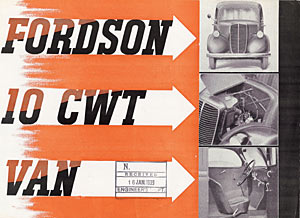
3. Press photo of an early Fordson E83W van.
All light commercials were worked hard, so it is highly unlikely that the first van on this page, registration LRE 431, is still around. The RE registration code was used by Staffordshire County Council, so there is a fair chance that this photo was taken in the Staffs area. The picture below shows a similarly-aged 10cwt van, photographed I think at the Dagenham works. Note the front bumper painted in white, and lack of window winders in the doors. The profile of the early type rear arch profile is clear in this shot. For comparison, a side-on view of a later E83W estate car has been included, featuring the later rear arch profile. In 2008 it was great to hear of an E83W van that had been with its owner for over 40 years, and still going strong. News of that van and its lucky long-term owner can be found here.
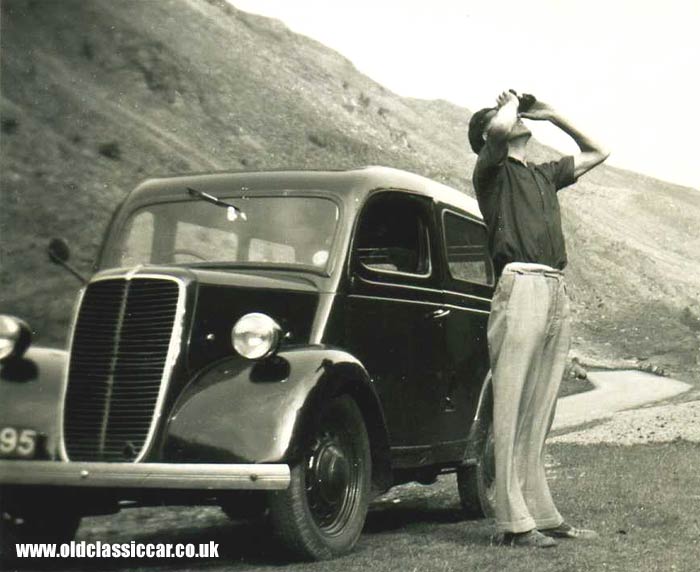
4. A 1939 10cwt Fordson on a couple's holiday.
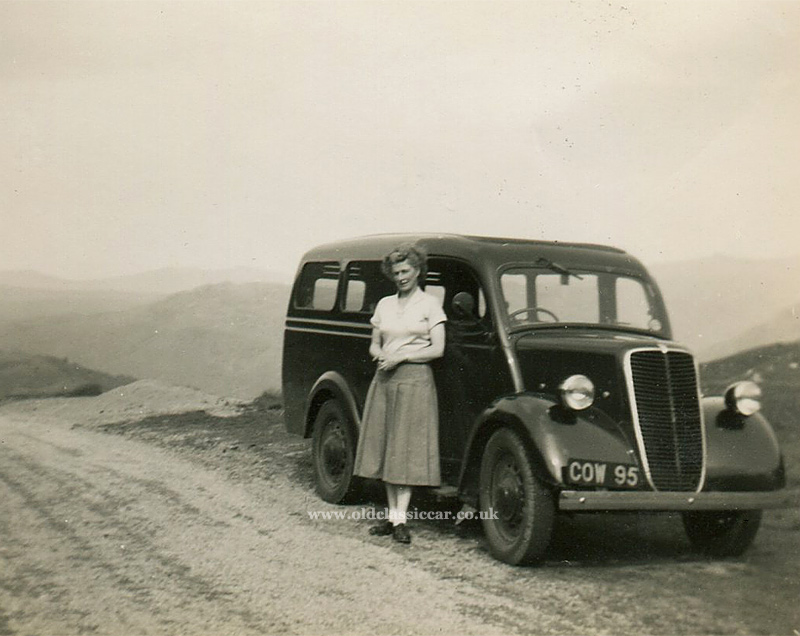
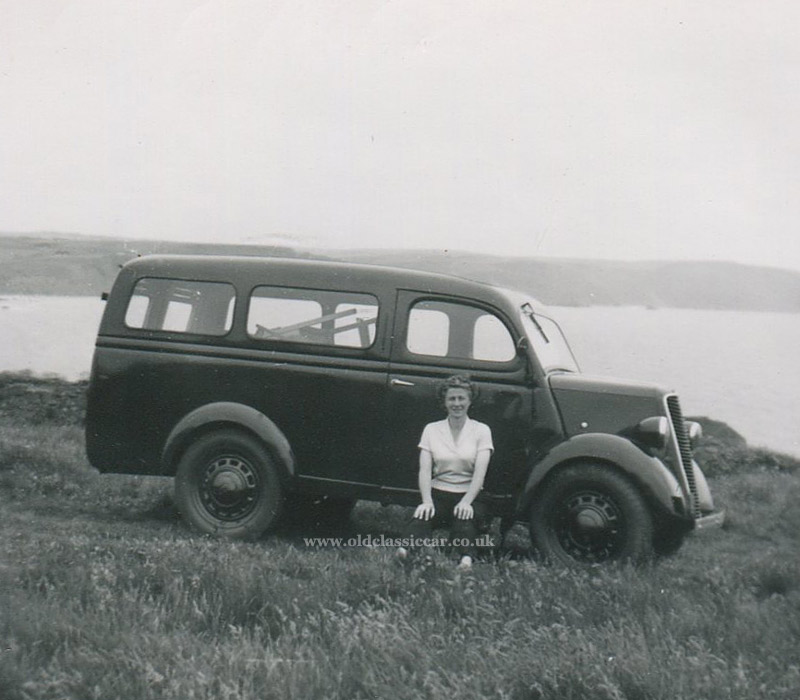
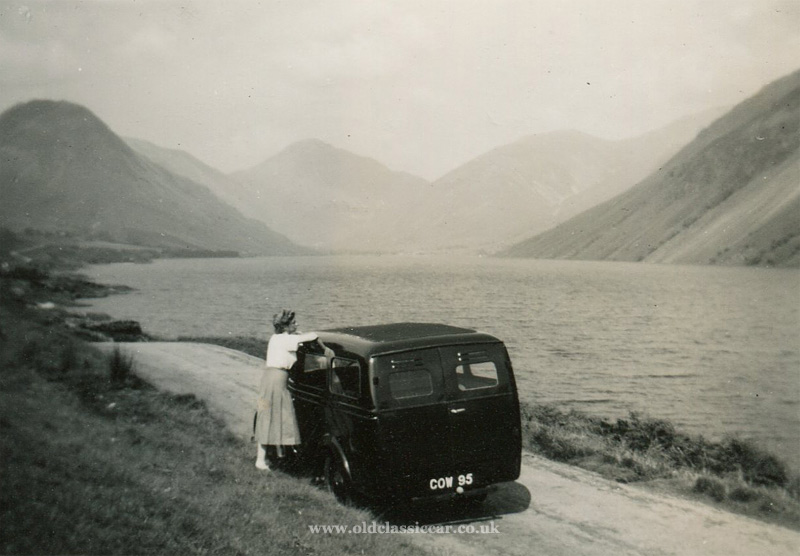
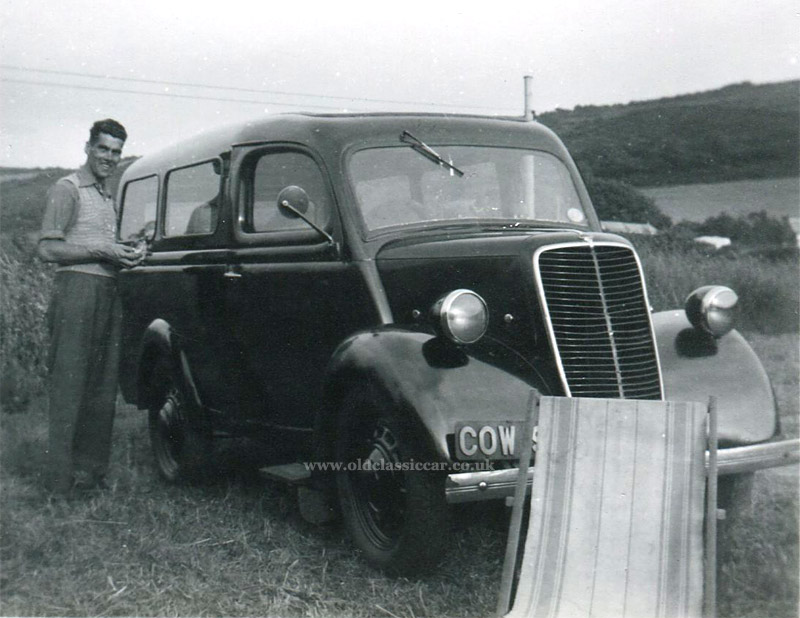
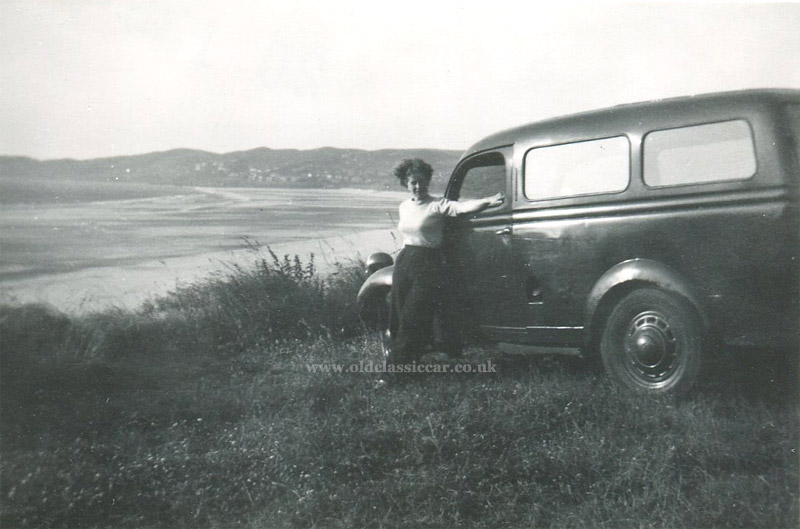
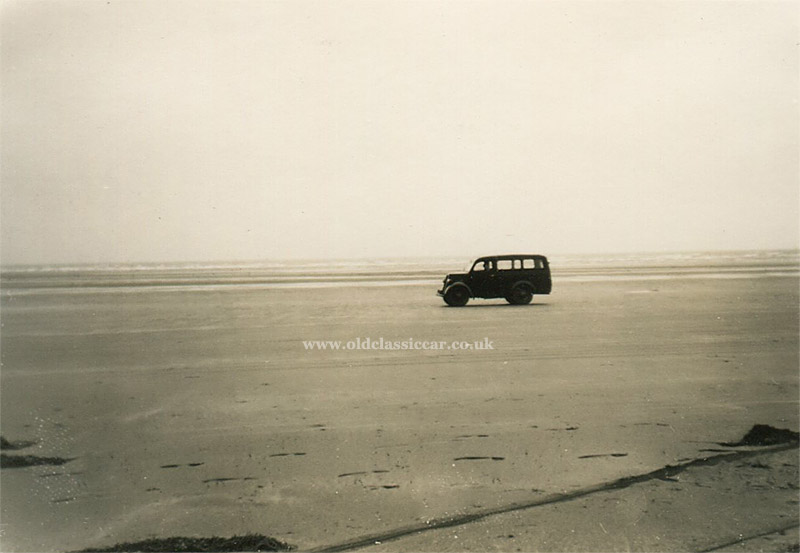
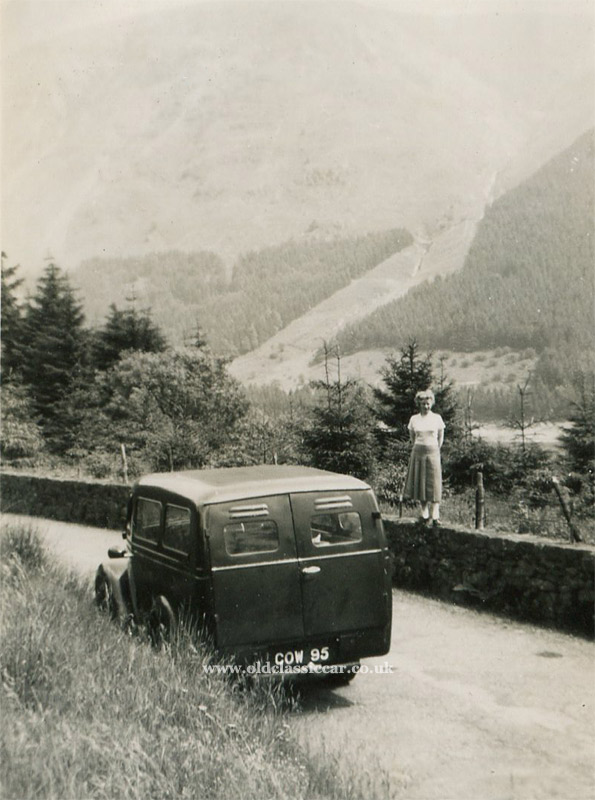
The following photographs from my own collection arrived in a set of images taken on a couple's holiday. They feature a dark-coloured Fordson van, registration COW 95. This series was introduced in June of 1939, and suggests that this van was registered not long after this date. Other signs that this is an early E83W include the non-beaded edge wings, lack of window pull-ups, the shape of the rear wheelarches, and the grille with just one starting handle hole. The first photo shows the van parked in a mountainous location, its owner gazing heavenwards through a pair of binoculars. Despite this van being an early one, it appears to have been fitted with the larger lamps usually found on later vans. Windows have also been cut into the rear side panels, a common modification.
(Please click the thumbnail to view full-size image.)
The second view of COW 95 is a side-on shot, with either a primitive caravan or a box trailer of some kind attached to the van's towbar. The trailer looks very close to the van from this angle, so care would need to be taken when negotiating tight turns, in order that the trailer didn't clobber the rear corner of the Ford.
More photographs of the same E83W.
I've scanned a further seven photographs of the same early example of Ford E83W van, regn. COW 95 (a Southampton issue). Here we have a front view of the Ford, with the lady of the couple posed alongside it. It's a shame that none of the photos has notes to advise where they were actually taken, or indeed when. These photographs bear witness to the vulnerability of the E83W's gently curving grille - despite the presence of a sturdy front bumper, so many examples have had their grilles dinged during their lives, and COW 95 is no exception. In all of these photographs, the grille is slightly bent and the centre stainless steel strip is missing.
Next, a side view of the trusty Ford, again with the young lady in view.
Wherever their road trip/holiday took place, the van's owners certainly visited some spectacular locations. Do these mountainous views ring a bell with anyone? Scotland, or the Lake District perhaps?
A front view of the parked E83W, with the gentleman of the pair shown this time, tucking into a sandwich while admiring the E83W's simple, curvaceous lines (!). Unusually for an E83W, this example appears to have a plated front bumper.
Here, two coastal locations feature in this couple's holiday snaps. The first sees the parked E83W overlooking a stretch of beach, while in the second, the 1/2 ton van is shown actually driving along on a sandy beach.
A second mountainous inland scene forms the basis of the final photograph that I have of COW 95. While the plucky E83W, with its very low gearing, wouldn't have been a road burner, its basic 1172cc sidevalve engine would have happily plugged away all day, enabling a comparatively comfortable cruising pace of 35 mph (or slightly less with the trailer that appears in one of the photos attached to the back).
5. Thames E83W van in London.
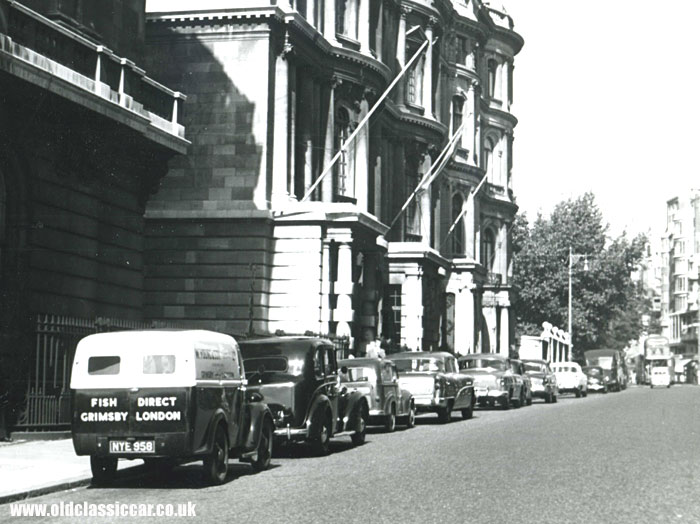
Now a photograph of a later, Thames-badged example of Ford's classic E83W van. The picture was taken on the afternoon of Tuesday 7th September, 1954, as part of a study looking at congestion and parking issues in London. The van belonged to Fish merchants W. Young & Sons Ltd, and was used on their regular delivery of fish from Grimsby to the capital. Note the minimalist lighting that came as standard fitment to these 1/2 ton vans, just a single stop/tail lamp mounted above the number plate, and semaphore indicators fitted within the bodywork just behind the front doors. The two small circular items either side of the number plate are the covers for the budget locks, installed into the drop-down spare wheel cover. An original factory rear view mirror is fitted to the offside, the mirror arm attached to the upper door hinge.
The registration, NYE 958, is a London series first used in July 1953.
A large black motor-car is parked just in front of the E83W (Wolseley perhaps). The diminutive estate car, with inset rear body panels, is a Fiat 500C Topolino Giardiniera. Several large American cars can be seen further down the road.
6. Esso Ford van and aircraft re-fuelling tanker at Elmdon Airport.
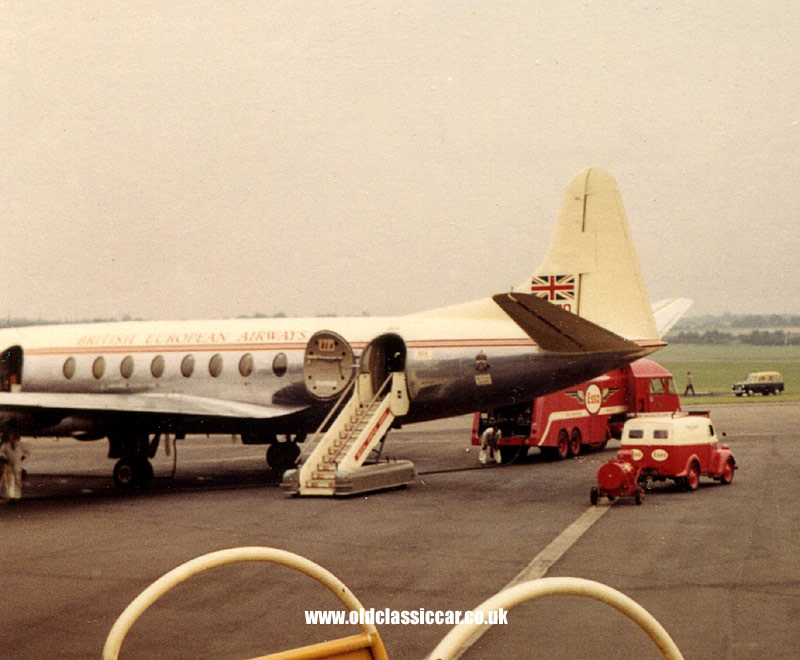
I'm a big fan of colour vehicle photos from the 1950s and 1960s, especially when they feature a variety of vehicles in them. This photo is a little cracker, taken in July 1960 at Elmdon Airport, now simply known as Birmingham Airport. Parked close to the BEA (British European Airways) Vickers Viscount is a Ford 10cwt van in Esso livery, towing behind it a small trailer. Parked to the far side of the four-engined propliner is a magnificent Esso fuel tanker, to the rear of which is a gent monitoring the flow of aviation fuel into the Viscount's tanks. Also visible is a Ford Escort (300E type). In the 1960s BEA operated a car hire scheme, details of which can be found on this page of the site.
Elmdon Airport was opened in 1939. During the war it was used for flight training (Royal Air Force and Royal Navy), as well as being a home to the
Fleet Air Arm. During hostilities, the Austin Motor Company produced Lancaster and Stirling bombers. They were transported by road to Elmdon, where the wings would be
installed, and the aircraft then flown from the aerodrome (by now featuring hard rather than grass runways) to undergo tests prior to entering service.
7. A post-war van that belonged to Wallasey Corporation.
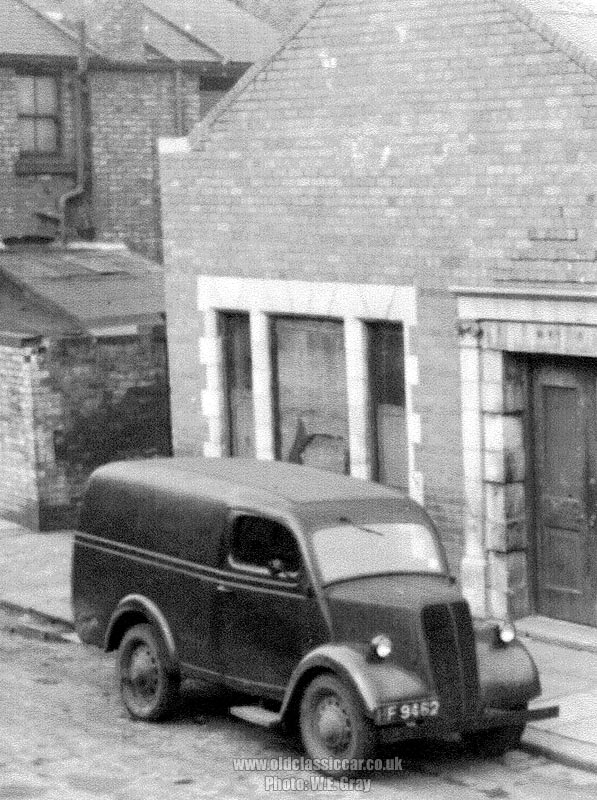
Ted recently sent over this aged photograph of an E83W van he learnt to drive on, in 1947 (thanks Ted), as he now relates:
"Learned to drive on this in 1947. Belonged to Wallasey Corporation Weights and Measures Dept., now part of
Merseyside Trading Standards Dept. Fitted with a passenger seat, and a bench and table in rear.
It carried 20 x 56lbs. weights for testing weighbridges, on other times scales
to test sacks of coal. Rear used to separate milk samples taken, one for
us, one for vendor and the other for the Public Analyst."
The van is registered HF 9462, part of a Wallasey series of registrations that lasted until October 1946. Several features tally with this van being built not long after WW2, namely the small headlamps and lack of bonnet badges, plus the shape of the rear arches. The grille bears evidence of a minor impact at some point, enough to dislodge the stainless trim that would have been fitted to it. The bumper is a little wonky too.
8. A one-off estate car.
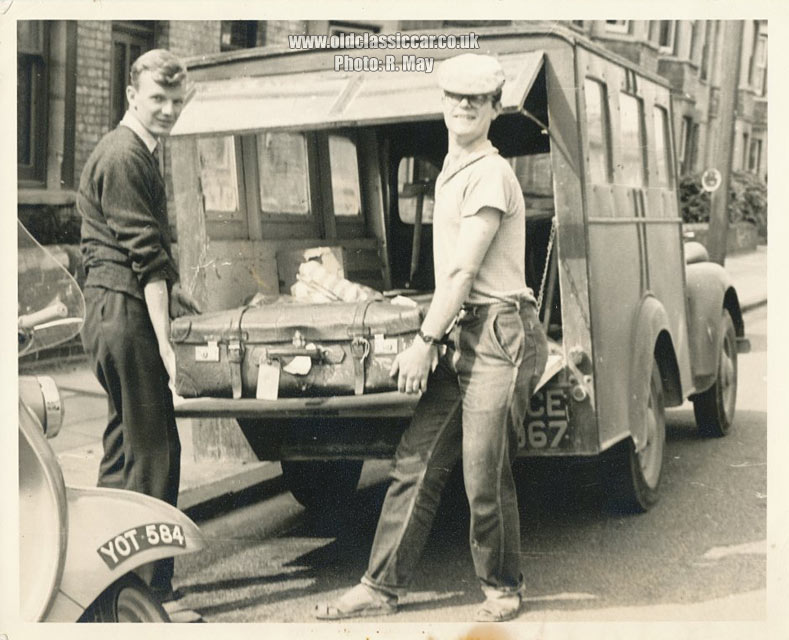
One of the attractions to me with old commercial vehicles, large and small, is the variety of uses they get put to. To this end, many get fitted with unusual designs of bodywork, some professionally-designed and fitted, others home-grown but all with a specific set of requirements in mind. This next photo was sent to me by Robert. His brother (on the right), and a friend, are shown with the estate car that Robert's father purchased in 1953. It had already been converted into an estate at this time. The registration number is GCE 967, which implies a registration date of late 1947 or early 1948 for this particular E83W.
The rear body sides, split tailgate and flooring were all manufactured from timber, quite an undertaking. It's great to see this one-off (I assume?) vehicle, many estates were simply conversions of vans, to which windows and a few seats were added - examples of which can already be seen on this page, but to see something built upon an early post-war E83W chassis, mated to the factory front end panelwork, is of real interest.
E83Ws were offered by Ford in a variety of guises, this one seems to have factory cab doors fitted to it, so could well have been supplied from new with the standard front doors and cab, albeit open-backed, awaiting fitment of an outside coachbuilder's own design of body. The scan shown at the foot of this page shows how the above Ford may well have looked when supplied new. The rear wings on this build are steel, and could have been cut from a van as the rear flared section has been cut away in this conversion, and exhibit the beaded edges found on vans by this time. The Ford looks to have the wide 16" rims usually found on the pickup version. Also note the scooter to the left, registration YOT 584 - this dates the photograph to 1960 or later. The van itself was scrapped in 1964/1965. My thanks to Robert for sending this over.
Return to Old Vehicle Photos Page 6. A second page of 10cwt van photos has now been added, this can be found here. Photos of an amazing articulated Bond Minicar transporter, based on an E83W, can also be found here. A video featuring a 1938 10cwt Fordson brochure can be viewed in the window below:
Custom Search
Old Classic Car (C) R. Jones 2026. Content not to be reproduced elsewhere.