
|
|

|
| See Homepage. | This page: Photo of this very rare Volkswagen-powered pick-up. |

|
| Old Classic Car Image Archive index > |
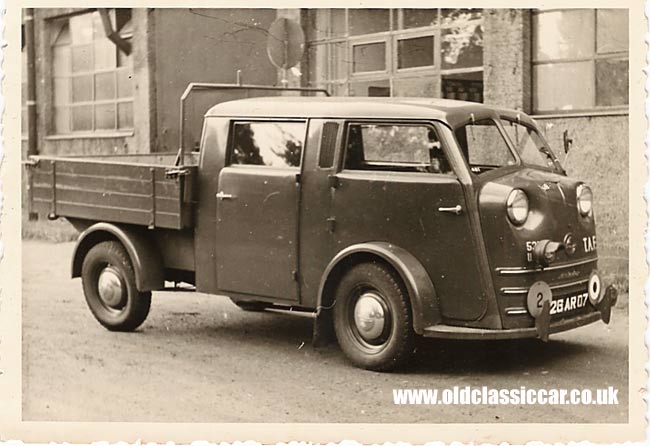
The Tempo MatadorOne of the rarest vehicles that appears in the period photographs section, is this interesting military-spec Tempo Matador. |
| Return to Motoring Photographs Page 2. |
|
| I think this photo was taken in Germany, but I'm not 100% sure which Air Force was using this unusual pickup. TAF suggests Tactical Air Force, but I'm sure someone will tell me exactly who used this van, registered 26 AR 07. Is this an RAF vehicle? |
|
Memories of a Tempo Matador at RAF Schleswig in Northern Germany. Roger dropped me a note in 2009, with his memories of just such a vehicle at a German RAF base in the 1950s: |
| "I was amazed to see your photo of the RAF Tempo Matador and I noticed your asking for any further information. I might be able to help a bit with that. |
| My father worked for the Air Ministry Works Department (AMWD) as a Station Engineer. The AMWD was responsible for all the facilities management and maintenance on RAF airfields throughout the world and therefore attached to the RAF. It was a British civilian staffed organisation which at that time came under the management of the Air Ministry in Whitehall. |
| In the mid to late fifties we lived at RAF Schleswig in Northern Germany and like at other camps we lived at, my Father had a fleet of vehicles under his management and in this instance, were mainly driven by German civilian drivers. |
| At Schleswig the vehicle fleet ranged from Volkswagen Beetle cars (with the split rear screen) at the lower end up through Borgward, Magerius Duetz, Mercedes and heavy haulage Faun and Krupp trucks at the top end. There was no difference between the RAF and the AMWD vehicles in appearance, they were all painted a dark green colour and all carried the same tactical and bridge weight markings, including the 2/TAF (2nd Tactical Air Force) and the RAF roundel. |
| Amongst this vehicle fleet was a Tempo Matador, identical in every detail to the one shown in your photo! It was used as a general run-around vehicle, much as a pickup is used today. I was to young to remember the exact registration number, but remember the Tempo well, having travelled in it on various occasions. |
| Here's a bit more useless information! When we moved there from the UK, the active aircraft in service there were De Haviland Mosquito's! and during our stay there the camp was handed over to the German Flugmarine. The British Naval Fleet Air Arm then started to train them to fly the Hawker Seahawk and the Fairy Gannet. |
| I hope the above is of some interest to you in identifying the photo of the Tempo Matador, for me, it brings back happy childhood memories, thank you." |
| Thanks for the info Roger, much appreciated! |
|
Background information on the Matador. The forward control Tempo Matador was made for only a few years after WW2, November 1949 through til May 1952, after which just 1,362 had been built. Power came courtesy of an aircooled VW (Beetle) engine, but this time mounted forward in the chassis and powering the front wheels. The Volkswagen factory gave the project its blessing and supplied the engine, yet was not involved directly in the sale of the vehicles. The Tempo factory was situated in Hamburg, Germany, and launched their range of light commercials ahead of VW getting its own vans rolling off production lines. It would seem that VW was slightly taken aback by the popularity of the Matador, so pulled the plug on the new engine supply, maybe to try and stave off competition for its own new vans? A large chunk of production ended up being exported to Australia. |
| The Tempo shown here has an extended cab, coupled with a dropside wooden pickup body - best of both worlds, and of a style common to modern pickup trucks that offer both a load-carrying ability, and room for 4 occupants inside. Note the positive camber angle of the rear wheel, surely a sign of independent rear suspension? |
|
Further information about these light commercials. Wade in Canada dropped me a note, with some more details on the Matador: "You mentioned in a short article about the Tempo Matador having a independant rear suspension. It does indeed have that. Coil spings in the rear and a single leaf spring in the front that spanned the distance between the steering knuckles. It had no upper control arms. The upper ball joint bolted directly to the leaf spring pack. The engines used were indeed VW's air cooled motors. When VW stopped being the engine of choice Tempo turned to Austin Healey/Martin and used their 1.6L power plant. The Tempo Matador name carried on well into the early 60's. The body style changed to look more like a VW minibus and they were offered as trucks, transport panel vans, multi-windowed passenger versions which included city buses and caravan styles. The names Wiking and Matador were 2 of the big sellers that Tempo offered in Germany. But they also had several larger utility versions that acted as tow trucks, street sweepers, garbage haulers and fuel tankers for airports. If you look up a website called "Tempo Diest" you will find all this info and more." |
| Thanks for the info Wade, here is the German Tempo Matador link that he refers to, for anyone wanting to find out more about these 'oldtimers'. A much smaller commercial, a three wheeler this time and also produced by Tempo (the 15-cwt Hanseat), can be seen here. |


|

Custom Search
|
 |
| Old Classic Car (C) R. Jones 2026. Content not to be reproduced elsewhere. |
| Website by ableweb. |
| Privacy Policy, Cookies & Disclaimers |