
|
|

|
| See Homepage. | This page: Reasons to buy a classic car: the environmental, financial and other benefits of driving an old motor. |
Why buy and drive a classic car?People buy old cars for many different reasons. For some the decision is driven by nostalgia for their past, while for others it may be the desire to drive something that stands out from the hordes of modern cars that populate our streets and car parks, computer-driven boxes, invariably painted silver or a shade thereof. This article will take a closer look at some of the reasons why the old-car fan chooses chrome over cup holders, and uniqueness before uniformity.Personally, I've had old cars since the mid-1980s, carrying on a family tradition for tinkering with older vehicles rather than obsessing over the latest must-have model, churned out in their thousands by soul-less car manufacturers, more often than not based in distant lands. From time to time I have run a more modern car, more out of convenience than anything else, but they hold very little interest for me, regardless of their indisputable ability to cover miles swiftly, in comfort and warmth, while soothing music emanates from all corners of the interior. Modern cars have their uses, especially when the weather is lousy or great distances need to be covered in a short space of time, but to me most are just another "white good", just like a toaster or a fridge, useful to have around, but not something to get excited about. Old cars though, whether a historic Hillman or an antique Austin, are a different kettle of fish altogether, as hopefully the following will explain. |
 I used this 1940's Austin for many years. |
The financial benefits of driving a classic motor.Financially, running an older car can make a great deal of sense when compared to a modern car, although it helps enormously if you're handy with a spanner, and don't object to the occasional dabble with a grease gun, for there's no denying that a classic does require far more owner-involvement than any modern, and not all garages understand older technology, many mechanics having been brought up on laptops and ECUs, rather than ignition points and cable brakes. |
| Buying and running a car such as a Morris Minor or Ford Anglia 105E for instance, can save you a useful sum in motoring bills over a typical year, when compared to a look-a-likey tin box of recent manufacture. Yes old cars do need parts replacing from time to time, as do moderns, but their design often means that parts can easily be interchanged from similar models of the same era, and even from cars of different make altogether. Thanks to the internet, finding parts to suit a classic car, even one that is fairly obscure, is more straightforward now than was the case 10-15 years ago in many cases. Cars of, say, the 1960s were designed and built by humans, and as a result were often maintained by the home mechanic with little more than a basic toolkit on his or her workbench. Failed components could be removed, dismantled, and re-furbished as required, then re-fitted to the car. Re-cycling and re-furbishing failed components was common practice in garages and workshops for decades, but developments in recent times mean that this simply isn't feasible to the same extent with the cars of today. If an alternator for example failed on a modern car, most garages would consign it to the nearest bin, order a brand new replacement, and present the car's owner with a bill for several hundred pounds. Should the dynamo pack up on a classic car, a stripdown and perhaps a new set of brushes would see it back in action, and ready for many more years' service. |
| Depreciation is another key disadvantage with the modern motor. Even fairly humdrum cars can cost 15k-20k to buy new, and they'll lose thousands during the first twelve months of service in depreciation alone. Add in the cost of dealer servicing, and the bills soon start to pile up, all for a car that (unless particularly exotic or rare) is losing money in value every day of the year, rain or shine, guaranteed. Home owners get very hot under the collar when the value of their house slips during a recession for instance, yet think nothing of losing 5k in a couple of years on the value of their new car, how sensible is that? Ok some people rely on their car for commuting, and have no interest in wielding feeler gauges or socket set spanners under the bonnet of their car, so will be happy to run a modern, despite it costing an arm and a leg, but for anyone willing to learn a little about what goes on under their car's bonnet, and is willing to accept that an older automobile will need more looking after, there are big savings to be made. |
 Looked after properly, this Triumph's engine should be very reliable, and is a doddle to work on. |
| Classic cars tend to hold on to their value much better than a modern - so long as they are well maintained. If you buy a popular classic such as a Minor, an A35 or a Viva, with routine maintenance there's no reason why it shouldn't still be worth the same as you paid for it, after several years' use. In rare cases your chosen steed may actually go up in value, but even if its value is maintained, that's a big saving over virtually any modern car you could name. Add in the cheaper cost of most spare parts for a common classic, when compared to a modern vehicle, and the savings keep piling up. |
| Drivers of older cars are typically believed to be more careful drivers, and this can lead to big savings on insurance when compared to a modern, although if you're under 25 years of age, you might have to shop around before an insurer will take you on. If you have a modern and a classic, you may well be able to insure the latter on a limited mileage policy. For a small-engined saloon of the 1960s say, your premium could well be under 100 GBP for fully comprehensive, agreed-value insurance, possibly with breakdown recovery included, although you may need to agree to a limited annual mileage to make really big savings on insurance. Park your car in a driveway rather than on the road, or in a garage if at all possible, and more savings can be made. |
| Road tax, or Vehicle Excise Duty as it tends to be known, is another factor to bear in mind. If you buy a car built 40+ years ago, and is registered as Historic rather than Private Light Goods, you'll qualify for zero-rated road tax. You still need to display a tax disc, as proof of also having an MOT (if needed, see below) and insurance (although on the day of taxing only mind...), but this again is a real benefit of driving an older car compared to something new, especially as the introduction of different tax bands - all in the name of Green so they say - in recent years has led to quite hefty sums being required to tax a modern car of even modest engine capacity now. |
| Mention of MOTs brings up another factor to bear in mind. MOTs are now no longer required for a car built 40+ years ago, on a rolling basis. Whether this is a good thing or not is open to often heated debate, but the fact remains that they are no longer compulsory, so in theory this could be another (albeit minimal) saving over the course of a year if you decide to run a car from the 1950s or before. |
 Old cars such as this Morris Minor can be quite fuel efficient too, if maintained in good order. |
| Many will argue that new cars are cheaper to run thanks to their fuel economy figures, and yes, new cars do often come with spectacular claims for their fuel efficiency, the downside is that actually achieving some of these figures in the real world can take some practice, and rarely are achievable on a typical commute in mixed driving. Modest saloons of the 1960s will achieve 35 mpg more often than not, and can usually run on unleaded quite happily without needing additives added to the tank, so are not necessarily that much worse on fuel than a modern petrol-engined equivalent, as the latter has to haul around large amounts of unnecessary weight, due to customers insisting on gadgets such as electric windows, power steering, central locking, air conditioning and other gizmos, even in quite modest machines. Significant motorway mileage in a classic can be hard going though, as they are often quite low-geared, so if regular motorway mileage is planned, some thought will need to be given to this, and options such as fitting alternative axle ratios and/or overdrive gearboxes considered. |
| If you're unfortunate enough to have a parking bump in your historic machine, the cost of replacing a bumper on a classic that is well-served by marque specialists will often be less than an equivalent part fitted to a new car, although the quality of reproduction parts can vary. If new-old-stock parts can't be found for a classic, chances are someone will have a usable secondhand equivalent tucked away and available for a few notes of the realm, another example of the financial benefits that driving a classic car can bring. |
The social side of motoring.Some people buy a classic to drive it every day, some to save money, while others opt for an older car for different reasons, one being the social side of driving something older than the typical car you'd see on our roads. It isn't unusual for drivers of classics to nod or wave at other owners of old cars that they encounter on the road, and this camaraderie often extends to helping out a fellow motorist if their car has expired at the side of the road. |
 Throughout the summer there are plenty of shows to take a car to. |
| There are owners' clubs for most makes and models of old car in the UK. Larger clubs have local meets, where enthusiasts can congregate, perhaps over a pint of something soothing at an agreeable public house, and discuss matters relating to their car(s). Road runs, informal shows, film nights and quizzes often form part of the club-members' experience. Even if nattering with other owners isn't your cup of tea, membership of a suitable club can be real help when it comes to technical information, and access to re-manufactured service parts that the club store may have in stock. While some clubs focus on a particular make and/or model of classic, others are region-based, inviting all enthusiasts into their fold, regardless of their vehicle, so long as it's suitably old and interesting. Some clubs have a sporting aspect to them, organising track days, sprint meetings and autotests, perfect if you like to exercise your classic away from the public highway as well as on it. |
Environmental benefits.Some eco-warriors will look at the driver of an older car with disdain, and make great play of how - in their view - environmentally-unfriendly old cars are. However, if these old cars are well looked after, they are in fact a perfect example of re-cycling, and maximising the use of something rather than simply disposing of it in the nearest scrapyard after just a few years, when it's no longer the new kid in town and newer, flashier models have replaced them in the showrooms. Most owners of old cars are in fact leading by example when it comes to re-using existing machines, rather than simply replacing them when they break. The old-car fan doesn't tend to follow fads and trends, and has no interest in impressing the neighbours with a newly-registered car on their driveway. They'd rather keep their old motor running, and after all, the manufacture of a car is a large constituent of its total contribution to pollution during its life, so it makes sense to keep cars that have already been built, running, even if their headline economy figures don't quite match those of a brand new car. Plus, new cars are often shipped to the UK from distant lands on huge vessels, which isn't something that our Green "friends" should be too impressed about I imagine - gone are the days when most cars in Britain were produced just down the road (relatively speaking) at Dagenham, Cowley, Coventry, Longbridge or Luton. |
 A DIY repair undertaken on a classic 1172cc Ford sidevalve engine. |
| What could be more environmentally-friendly than repairing a small component within a sub-assembly on a car, rather than simply replacing the sub-assembly with a new replacement? In many respects manufacturers of new cars should look back at how they used to build cars, and make their cars simpler and easier to maintain, with the emphasis on re-using and repairing worn-out parts, rather than forcing motorists to replace with new. But as these manufacturers make a lot of money through the supply of new parts and servicing fees which are forced onto the new-car buyer in order to keep their warranty intact, they're unlikely to make their cars more user-friendly any time soon. |
| At the end of the day, all cars create pollution of some kind or other, but extending the useful life of any vehicle has to be a good idea. So anyone who chooses to re-use an old car, maintaining it in good order long after its original designers had intended them to serve, should be congratulated in my opinion, just as those who renovate older houses rather than replace them with new, should be too. |
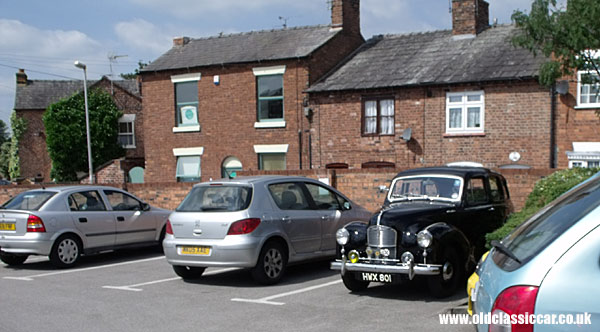
Being different.Your neighbours might think that you're a bit weird in choosing a historic motor rather than a new one, but who cares what they think. Look in any supermarket car park, and you'll see line upon line of over-sized hatchbacks and MPVs, usually painted black, white, or a silvery hue somewhere between the two, bursting at the seams with technology. Some people are happiest following the herd, being like everyone else, and taking the easy option, and that's fine. Others though like to do things a little differently, eschewing the easy way of doing things and opting for cars (and often clothes, houses, interior decor and so on) that reflect their slightly eccentric or individualistic take on life. Most aren't show-offs though, they just like to do things their own way rather than being like the majority just for the sake of it. |
| There's something about the styling of many old cars that really appeals to me too. I also find people's reactions to old cars of interest. Some wave angrily if they feel that their journey has been slowed down by a few seconds thanks to the presence of an old car ahead, while others seem to like seeing classics still in use. Often strangers wander over for a chat if they see an old car in use, only the other day a lady appeared at my window, reminiscing about her first boyfriend and his Austin 7 Ruby. I doubt that would have happened had I been sat in a Signum, or a Mondeo. Let's hope that we're allowed to exercise our freedom to drive old or new cars for many years to come, despite the best efforts of certain pressure groups, political bodies, and well-funded climatologists to try and put a brake on such activities. Ladies and Gentlemen, start your engines!! :-) |
 There's a lot to be said for driving an older motor-car, such as this Volvo I owned on two separate occasions. |
| So, now that you've come to the sensible conclusion that running a classic is a great decision on many levels, have you decided upon what type of classic to go for ???? |


|

Custom Search
|
 |
| Old Classic Car (C) R. Jones 2026. Content not to be reproduced elsewhere. |
| Website by ableweb. |
| Privacy Policy, Cookies & Disclaimers |