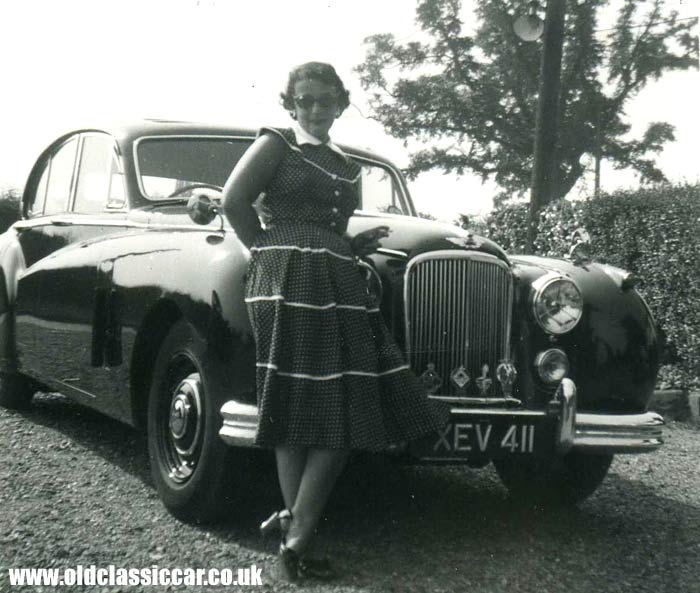
All ready for Goodwood, in a MkVII Jaguar?
This could easily be a scene captured at a Goodwood Revival meeting, a smart lady dressed in appropriate 1950s attire, stood by her wonderful old Jaguar, in this case a MkVII or MKVIIM saloon of the early/mid fifties. For any lady out there wishing to capture the correct 'Goodwood' look, replicating the outfit shown here would be a good starting point. Does XEV 411 (an Essex registration) survive perhaps? maybe it is slumbering in a dusty barn somewhere, just waiting to be restored one day? This particular MkVII sports a fine set of badges in front of the radiator grille, the AA and RAC badges are easily identifiable, while the third badge resembles the logo used at the Festival of Britain in 1951.
|
|
|
The MkVII Jaguar was launched in 1951 and continued in production until 1956, by which time the MkVIII was ready for the buying public. Powered by the 3.4 litre XK engine first seen in the XK120 sports car, the MkVII certainly had a respectable turn of speed, even if the two seater Jaguar sports cars would easily show it a clean pair of heals. The MkVII not only sold well in roadgoing trim, it also had a number of successes in motorsport - the photos on this page for instance show two racing-prepared MkVII Jaguars, both prepared for the Monte Carlo Rally (one in 1952, the other in 1955).
|
|
This car's chassis was based on that found on the previous MkV, a large saloon introduced in 1948 (the same year as the XK120) but unlike the sportscar, it did not come fitted with the XK engine. Whereas the MkV incorporated many styling cues from the pre-war SS Jaguars, the curvy MkVII brought the Jaguar saloon range right up-to-date, with headlamps incorporated within the front panel, and a less imposing radiator grille up front. Unlike the MkV though, which had a flat one-piece windscreen, the MkVII was fitted with a split screen arrangement, better able to fit in with the curving roofline. |
|
In 1954 the MkVIIM was introduced, basically a revised version of the previous MkVII. It still came with the 3.4 litre powerplant, although the quoted power output was slightly improved, as was the top speed (approx 104 mph in favourable conditions). For the first time British buyers could now choose an automatic gearbox, instead of the four speed manual found in the MKVII. Buyers overseas had had the option of an auto 'box since 1953.
|
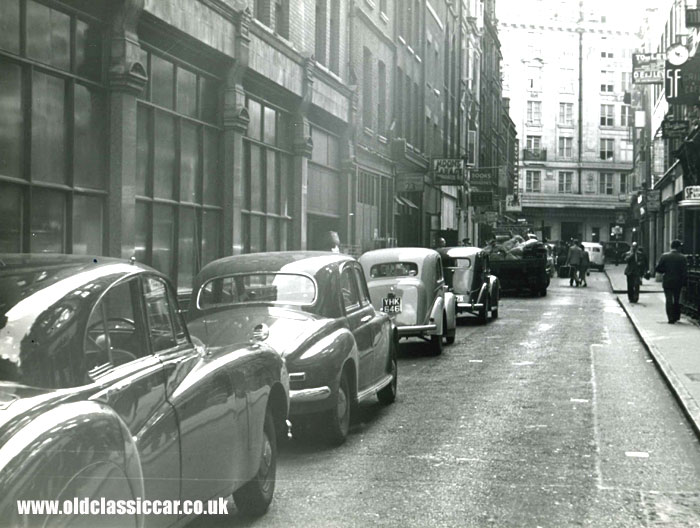
A MkVII Jaguar in London, 1954.
This photograph features a varied selection of classic vehicles with, nearest the camera, the shapely rear 3/4 view of a MkVII Jaguar saloon in sight. The presence of an aerial fitted to the front wing suggests that the Jaguar's owner enjoyed listening to a tune while driving his capacious 3.4 litre motor-car. What though is the small dome-headed fitting bolted to the roof, just above the driver's door? The scene is Denman Street in London, as captured on film at 3.45pm on Tuesday 7th September 1954.
|
|
Ahead of the swooping Jaguar is an example of Rover 90 (P4), with two classic sidevalve-powered Fords - a nearly-new Anglia, and an E493A Prefect, also in attendance. A lorry belonging to "Lovell and Son Ltd" can be seen unloading, while in the distance a small - French? - van is stopped. Above the Prefect and attached to a building there is a sign for Moon's Garage, directing customers down a side street close to the SF Grill & Cafe. Another cafe can be seen further up on the lefthand side, as can a sign for a shop selling books and magazines.
|
| (Please click the thumbnail to view full-size image.) |
|
|
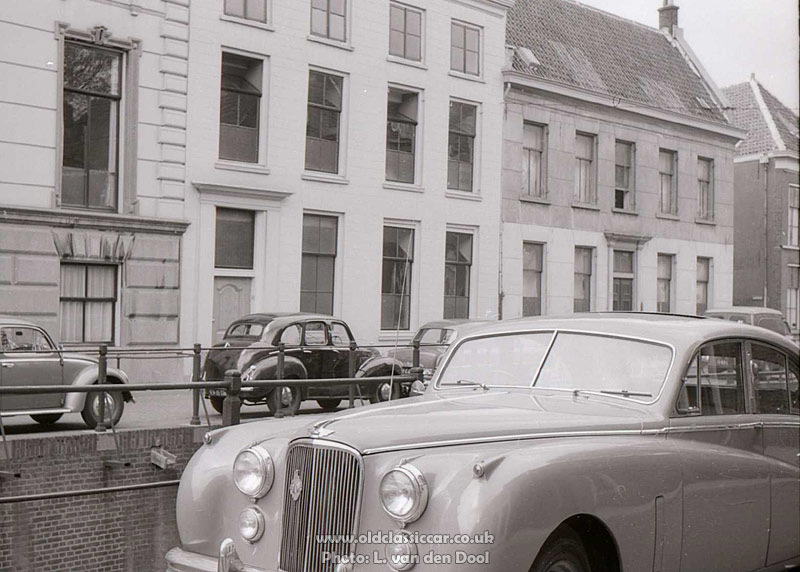
Another example, this time in the Netherlands.
Once again I'm indebted to Leo for sending over another period photograph featuring now-classic cars. The following shot was taken in Utrecht during a trip there in 1958. Here, he captures on film a magnificent Mk7 Jaguar, a true classic if ever there was one. Accompanying the Jaguar are two other saloons produced by the British motor industry in the 1940s/1950s, namely a four-door Austin A40 Devon, and a Mk1 Ford Consul. Just in sight is small commercial vehicle, which looks suspiciously like a Morris Series III van, based on the contemporary Cowley, while to the left is an example of VW Beetle.
|
|
|
|
Return to Old Vehicle Photos Page 8. A fine old colour photo of a Mk9 saloon can be found on this page.
|